OUR LATEST RESEARCH REPORT
Hong Kong’s judicial manpower problem is best understood as a supply-and-demand mismatch. On the demand side, courts face high caseloads, persistent vacancies, concentrated criminal waiting-time pressure and rising expectations from the public, businesses and international legal users. On the supply side, Hong Kong has many legally trained people, including law students, recent graduates and junior legal professionals. The difficulty is that the existing system does not connect this younger talent pool to the future judicial pipeline early enough.
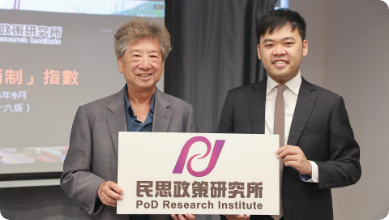
POD Research Institute (PODRI) announced its latest round of the ‘One Country Two Systems’ Index on March 31. The latest reading is 6.11, a 0.5% decrease from the previous round. The Index objectively assesses the current state of ‘One Country Two Systems’, compiled from university public opinion surveys and international institutional ratings, comprising 6 pillars and 24 sub-pillars. It is worth noting that the polling period of this report follows the aftermath of the Jimmy Lai case and the Tai Po Wang Fuk Court fire which undoubtedly had a negative impact on the mood of the community and affected the polling results.
Hong Kong faces an urgent need for economic diversification, transitioning from its traditional finance and tourism sectors to a knowledge-based economy. Despite possessing world-class universities – a significant yet underutilized asset – the city is currently failing to fully capitalize on the immense global education market, projected to reach $10 trillion by 2030, primarily due to the absence of a comprehensive city-level strategy. Leveraging international experience, particularly through diverse Transnational Education (TNE) models, Hong Kong can harness its unique advantages, such as "One Country, Two Systems," strong ties with mainland China, and its status as an international metropolis. This strategic shift promises not only to stimulate economic growth and create high-value jobs but also to significantly enhance its international reputation and soft power. Therefore, developing and implementing a robust education export strategy is paramount for Hong Kong's future prosperity.
The tragic Wang Fuk Court fire underscored the need for proper maintenance and revealed systemic vulnerabilities. This discussion paper explores the roots of bid-rigging in Hong Kong's maintenance sector, examines current policies, and proposes actionable risk control strategies based on best practices.
This paper explores Hong Kong’s AI development compared to Singapore, Japan, and China Mainland. Drawing on data (2021–2025) and stakeholder interviews, it evaluates performance across seven factors and proposes policy directions to boost competitiveness in AI. 【Read more】
Amid ongoing U.S.-China trade tensions and new tariffs, the POD Research Institute (PODRI) announces its inaugural report, 'Hong Kong Economic Health Check 2025.' This report offers insights into Hong Kong's economic resilience and strategic responses to tariff impacts. 【Read more】
PODRI announced the latest "One Country, Two Systems" Index, recording a score of 6.15, a modest increase of 0.16% compared to the previous round.

 EN
EN Login
Login Donation